
Bronte Harbour Classic 2026: Results, Recap & 5K Takeaways
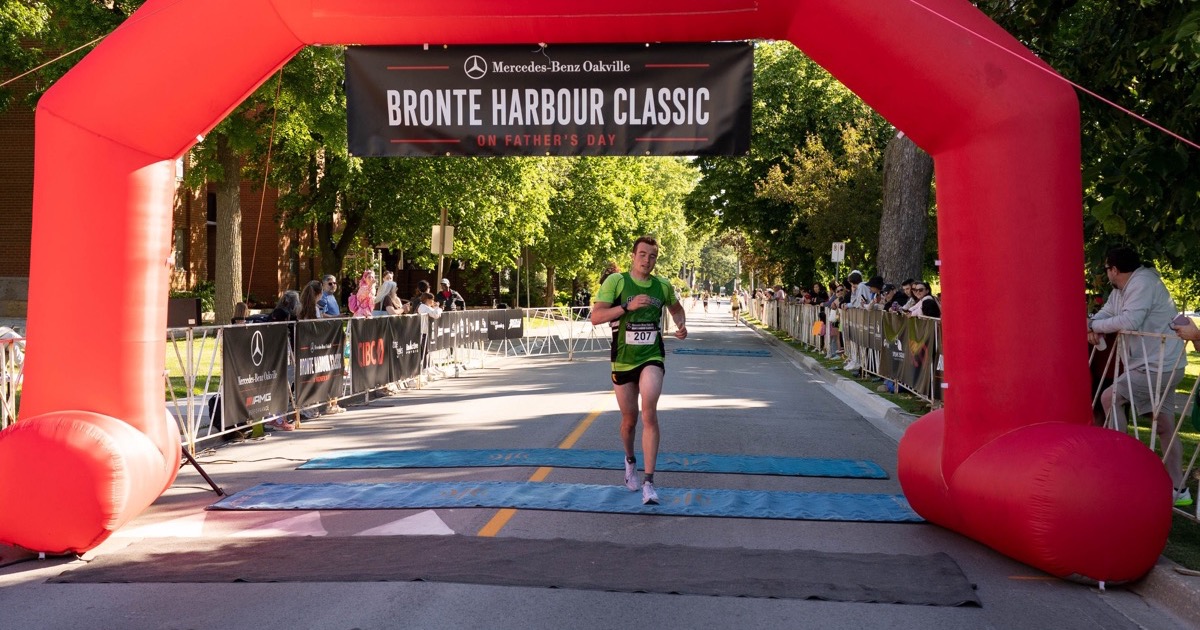
The inaugural Bronte Harbour Classic delivered one of the fastest community 5K fields the Halton region has seen — three runners broke 15 minutes, led by Adam Schmidt’s 14:43, in front of a sold-out crowd of 900+ on Father’s Day. This guide has the full results, then turns the race into something you can use: a data-backed breakdown of 5K pacing, recovery, shoe mileage, and how to run your next one faster.
Quick Answer: The Bronte Harbour Classic 5K was held June 21, 2026 in Oakville, Ontario, and sold out with 800+ runners in the 5K plus 130+ in the kids’ 1K (900+ total). Adam Schmidt won in 14:43 (a 2:57/km pace), with Owen Parkes (14:55) and Lucas McAneney (14:57) also breaking 15 minutes. Sadie-Jane Hickson was the first woman in 16:34.
Bronte Harbour Classic 2026 results
The front of the Bronte Harbour Classic ran times you’d expect at a regional championship, not a first-year community race. Three men broke 15 minutes — 2:59/km or faster — and chip timing captured every finisher on a flat, fast course beside Lake Ontario.
| Place | Runner | Chip Time | Pace |
|---|---|---|---|
| 1 | Adam Schmidt | 14:43 | 2:57/km |
| 2 | Owen Parkes | 14:55 | 2:59/km |
| 3 | Lucas McAneney | 14:57 | 2:59/km |
| 4 | Caleb Beland | 15:03 | 3:01/km |
Sadie-Jane Hickson was the first woman across the line in 16:34 — a time that wins the open category at most local 5Ks outright. But the real story wasn’t the elites; it was the 900+ runners of every level who made a first-year event sell out.
The kids’ 1K went off at 8:00 AM and the 5K at 8:30, under clear, warm skies. Be Active Physio helped prepare athletes beforehand and a St. John Ambulance medical team covered the course — the kind of support that lets you race hard knowing someone has your back.
5K pacing strategy: what the fast field actually did
The most efficient way to race a 5K is to run close to even pace, with — at most — a slight negative split, and the winning ride at Bronte shows why. Adam Schmidt’s 14:43 was an almost metronomic 2:57 per kilometre. He didn’t sprint the first kilometre and survive; he ran the same hard, controlled pace the whole way.
This is where a lot of online advice gets it wrong for the 5K distance. Here’s the honest, evidence-based picture:
- The physiology favours negative splits in theory. Research on pacing (including work indexed in the U.S. National Library of Medicine) shows athletes who run the second half slightly faster tend to post better times and less physiological strain — because they avoid the early oxygen debt that wrecks the back half.
- But a 5K is short and brutally intense. Many experienced racers find that aggressively trying to negative-split a 5K backfires — you bank too little in the first half and can’t make it up in 2,500 metres. The practical sweet spot for most runners is even pacing with a strong final kilometre, not a deliberate slow start.
Quick Answer: For a 5K, aim for even splits with a slightly faster final kilometre. A true negative split (running the back half faster) works for longer races but often backfires over 5K because the distance is too short to recover lost time. The biggest mistake is a positive split — going out too fast and fading — which almost always produces a slower finish.
The takeaway isn’t a rigid rule; it’s that you need to know your own splits to fix your pacing. Which brings us to the data.
How to read your race data and run smarter
The fastest way to improve your 5K is to review your kilometre splits after every race, because pacing — not fitness — is what most runners actually get wrong. Open the race in RunMate Pro and read three numbers:
- The spread between your fastest and slowest kilometre. Under ~5–8 seconds means you paced it well. A 20-second-plus gap means you went out too hot — a pacing problem you can fix immediately, with no extra fitness required.
- The exact point you slowed. GPS tracking pinpoints where your pace dropped — often the same hill or the same kilometre every race. That’s your specific thing to train.
- Your finishing kick. A big final-400m surge is a good sign you had more, and could have started a touch harder. No kick at all usually means you over-spent early.
Do this for three or four races and your pattern becomes obvious. That’s the whole point of run tracking: not the badge of a logged run, but the feedback loop that makes the next one faster.
Recovering after a hard 5K
A 5K is short, but a genuine race effort still earns real recovery, and the 48 hours afterward decide how fast you bounce back. You don’t need full rest — light, easy movement (a walk or very easy jog), good sleep, and steady hydration restore you faster than sitting still. Most runners can return to easy running within a day or two and to hard efforts within about a week, scaled to how hard they raced.
If a niggle flared on the fast kilometres — a tight calf, a cranky knee, an Achilles that complained — support it through the easy days. A bit of kinesiology tape can add support and body awareness while the area settles, so a one-day grumble doesn’t become a two-week layoff. Tape handles the moment; sleep, easy miles, and patience handle the rest.
When to replace your running shoes
Most running shoes need replacing every 480–800 km (about 300–500 miles), and worn-out shoes are one of the most common — and most preventable — causes of running injury. That 300–500 mile range is the consensus you’ll see from REI, Runner’s World, and most major retailers and running publications. A few refinements worth knowing:
- Lightweight and racing shoes wear faster — often 400–480 km (250–300 miles) — because the thin, soft midsoles that make them fast also break down sooner.
- Think in months too: a regular runner often hits replacement around every 4–6 months.
- Be honest about the evidence. Some publications, including The New York Times and Runner’s World, point out there’s surprisingly little hard science behind the exact 300–500 number. So treat it as a planning range, not a law — and pay attention to how your legs feel.
The catch is that midsole breakdown is invisible: the shoe looks fine while the cushioning quietly stops working, and your joints absorb the difference. That’s why tracking matters. RunMate Pro logs the kilometres on every pair you own automatically, so you replace shoes on data instead of guessing — and you stop running a dead pair into the ground, which is a fast track to shin splints, plantar fasciitis, and knee pain. A hard 5K counts double here: race efforts accelerate midsole wear.
Train so your next 5K is faster
Most overuse injuries don’t come from one hard run — they come from doing too much, too soon, which is the one variable you fully control. The widely used guideline is to raise your weekly running volume by no more than about 10% per week, giving tendons, bones, and connective tissue time to adapt. It isn’t a law of physics, but it’s a sensible ceiling, and the runners who respect it are the ones who reach the start line healthy.
Pair that with what every fast finisher at Bronte had in common: consistent easy mileage, a little structured speed work, fresh shoes, and recovery taken as seriously as the hard days. RunMate Pro keeps those trends in front of you — weekly load, shoe mileage, pacing — so the patterns that cause injuries show up as numbers before they show up as pain.
Frequently Asked Questions
What were the Bronte Harbour Classic 2026 results?
Adam Schmidt won the inaugural Bronte Harbour Classic 5K in 14:43 (2:57/km), followed by Owen Parkes (14:55) and Lucas McAneney (14:57) — three finishers under 15 minutes. Sadie-Jane Hickson was the first woman in 16:34. Held June 21, 2026 in Oakville, the race sold out with 800+ runners in the 5K and 130+ in the kids’ 1K.
Is a sub-15-minute 5K fast?
Yes — a sub-15:00 5K is an elite-level time, requiring about 2:59 per kilometre (4:49 per mile) sustained for the full distance. It’s typically the territory of competitive club and university athletes, and very few recreational runners reach it. Three runners breaking 15 minutes at a first-year community race is an unusually deep field.
Should you negative split a 5K?
Not aggressively. While research shows negative splits (running the second half faster) are efficient for longer races, a 5K is too short to recover time lost to a deliberately slow start. Most runners race a 5K best with even pacing and a slightly faster final kilometre. The cardinal sin is a positive split — going out too fast and fading.
What is the best pacing strategy for a 5K?
Aim for even kilometre splits — each within a few seconds of your average — and save a little for a strong finish. Going out hard and slowing down almost always produces a slower overall time. Reviewing your GPS splits after each race is the quickest way to learn whether your pacing is costing you seconds.
How long should I rest after running a 5K?
Most runners return to easy running within one to two days and to harder training within about a week, adjusted for race effort and how they feel. Active recovery — easy walking or jogging, sleep, and hydration — generally restores you faster than complete rest. Sharp or persistent pain is different from normal soreness and is worth a professional assessment.
How often should I replace my running shoes?
Replace most running shoes every 480–800 km (about 300–500 miles); lightweight racing shoes wear faster, around 400–480 km (250–300 miles). Because midsole cushioning breaks down before the shoe looks worn, tracking each pair’s mileage — which RunMate Pro does automatically — is the most reliable signal it’s time, along with new aches or a “flat” feeling underfoot.
Why do my running shoes feel flat or dead?
A “flat” or “dead” feeling usually means the midsole foam has compressed and lost its rebound and shock absorption, even though the outsole and upper still look fine. It’s one of the clearest signs a shoe is near the end of its life. If you notice it alongside new soreness in your shins, knees, or feet, check the pair’s mileage and plan a replacement.
How accurate are GPS running apps for splits?
Modern GPS running apps are accurate enough for pacing decisions — typically within a small percentage on open courses — though tall buildings, tree cover, and tunnels can introduce error. For analyzing a race, the relative pattern between your kilometre splits matters more than the absolute number, and that pattern is reliable enough to guide how you pace your next race.
The bottom line
The first Bronte Harbour Classic was fast at the front, welcoming throughout, and a genuine success — a sold-out field, three sub-15:00 finishers, and a safe, well-run morning. Whether you raced it or you’re chasing your own PR, the path forward is the same: pace by even splits, recover deliberately, run in fresh shoes, and build your mileage patiently. Read the official Bronte Harbour Classic 2026 recap for the full event story, and track your training with RunMate Pro so you’ve got the data to run a smarter race next time.
Ready to run smarter?
Download RunMate Pro free on iOS — no account, no ads, no noise.
Download Free on iOS